
Year: 2014

NASA Earth Observatory image by Jesse Allen and Robert Simmon, using data from the Land Atmosphere Near real-time Capability for EOS (LANCE). Caption by Adam Voiland.

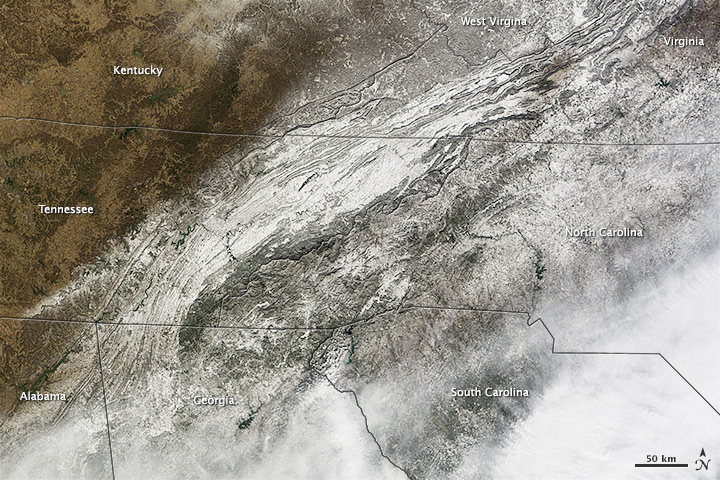
A large winter storm swept through the southeastern United States in January 2014, dropping snow and ice on an area unaccustomed to dealing with winter weather.

While clouds still covered most of the area affected by the storm when the Terra satellite passed over on January 29, 2014, the Moderate Resolution Imaging Spectroradiometer (MODIS) on board captured this view of snow on the ground in parts of northern Georgia, northern South Carolina, eastern Tennessee, and western North Carolina. According to the National Weather Service, the storm dropped up to 9 inches (23 centimeters) of snow in parts of North Carolina, 4 inches (10 centimeters) in parts of South Carolina and Georgia, and 2 inches (5 centimeters) in parts of Tennessee. Atlanta received 2.6 inches (6.6 centimeters) of snow. Many areas also received significant amounts of freezing rain and sleet. Read more

NASA Earth Observatory image by Jesse Allen and Robert Simmon, using data from the Land Atmosphere Near real-time Capability for EOS (LANCE). Caption by Adam Voiland.
NASA image courtesy Jeff Schmaltz, LANCE MODIS Rapid Response. Caption by Adam Voiland.

A layer of haze filled China’s Sichuan Basin on January 23, 2014, when the Moderate Resolution Imaging Spectroradiometer (MODIS) on NASA’s Terra satellite acquired this natural-color image. The haze obscured many features usually visible in satellite images of the area, including Sichuan province’s largest city, Chengdu. In the eastern part of the basin the tops of a series of ridges were visible above the layer of pollution. Skies were clear in the highlands west of the basin, while tendrils of pollution snaked into valleys northeast and southeast of it. Read more

NASA image courtesy Jeff Schmaltz, LANCE MODIS Rapid Response. Caption by Adam Voiland.

NASA images courtesy LANCE/EOSDIS MODIS Rapid Response Team at NASA GSFC. Caption by Holli Riebeek.

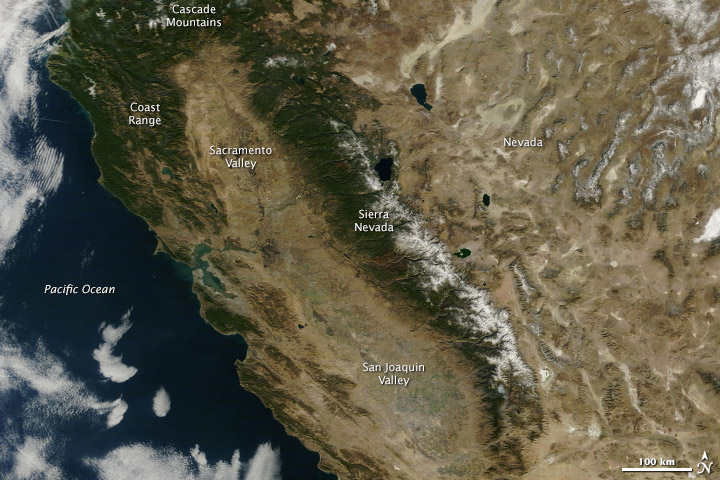
2013 was a dry year for California, but it has nothing on 2014 so far. January is on track to be California’s driest on record, and since the state receives half of its precipitation between December and February, it appears that the 2013-2014 water year could be the driest on record too. With that possibility in view, California governor, Edmund G. Brown, Jr. declared a state of emergency on January 17, urging Californians to conserve water.

From brown landscapes to the bare mountains, California is clearly dry in this view from the Moderate Resolution Imaging Spectroradiometer (MODIS) on NASA’s Terra satellite, taken on January 18, 2014. The lower image, taken on January 18, 2013, contrasts last year’s drought conditions with the extreme conditions currently in place. Read more

NASA images courtesy LANCE/EOSDIS MODIS Rapid Response Team at NASA GSFC. Caption by Holli Riebeek.

NASA image by Holli Riebeek and courtesy LANCE/EOSDIS MODIS Rapid Response Team at NASA GSFC. Caption by Michael Carlowicz.

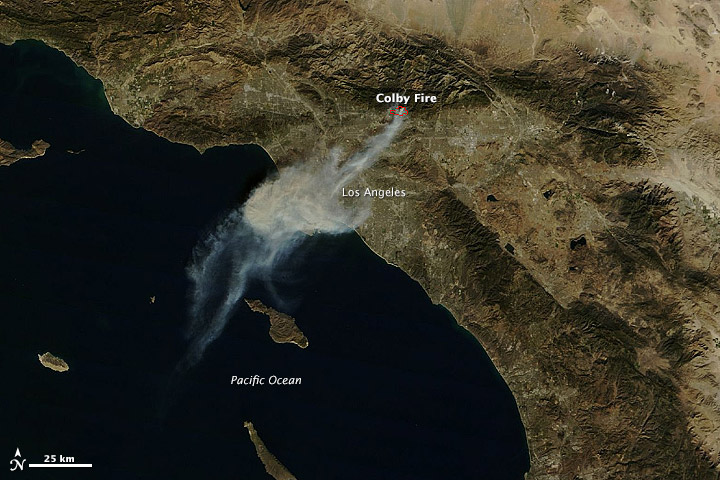
A wildfire started and spread quickly in the foothills northeast of Los Angeles on January 16, 2014. The plume of ash and smoke blanketed much of the metropolitan area and prompted air quality warnings.

The Moderate Resolution Imaging Spectroradiometer (MODIS) on NASA’s Terra and Aqua satellites captured these images of the Colby fire just before (top) and just after noon on January 16. The morning image is clearer because the scene was centered under the satellite, while the afternoon image is fuzzy because the satellite was observing from an angle. Read more

NASA image by Holli Riebeek and courtesy LANCE/EOSDIS MODIS Rapid Response Team at NASA GSFC. Caption by Michael Carlowicz.

NASA Earth Observatory image by Jesse Allen and Robert Simmon, using data from NASA/GSFC/METI/ERSDAC/JAROS, and U.S./Japan ASTER Science Team. Caption by Adam Voiland.

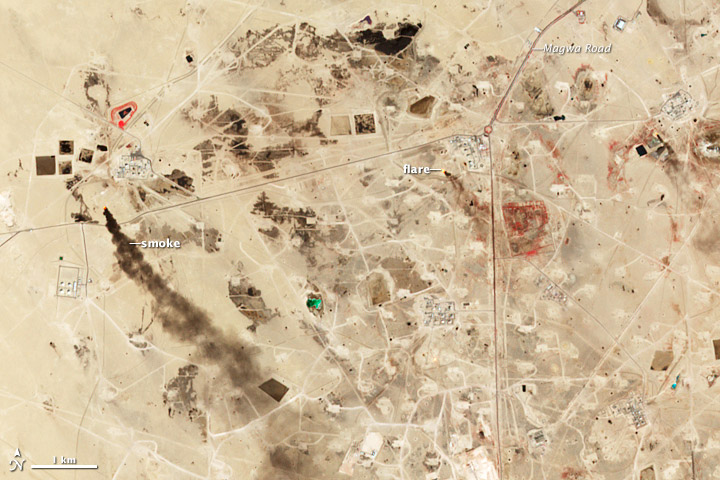
Though a small nation, Kuwait has an outsized role in oil production. The country has an estimated 94 billion barrels of proven oil reserves, about 9 percent of the world’s total. The oldest and largest of Kuwait’s oil fields-the Greater Burgan field in southeastern Kuwait-produces about 1.6 million barrels of oil a day.

The Greater Burgan is comprised of three smaller fields: Burgan, Magwa, and Ahmadi. The first oil well was installed in Burgan in 1938. Oil was discovered at the Magwa field in 1950 and at the Ahmadi field in 1952. The Advanced Spaceborne Thermal Emission and Reflection Radiometer (ASTER) on NASA’s Terra satellite captured this image of a portion of the Burgan field on September 27, 2009. Read more

NASA Earth Observatory image by Jesse Allen and Robert Simmon, using data from NASA/GSFC/METI/ERSDAC/JAROS, and U.S./Japan ASTER Science Team. Caption by Adam Voiland.