Tag: Atmosphere

Atmosphere News and Events

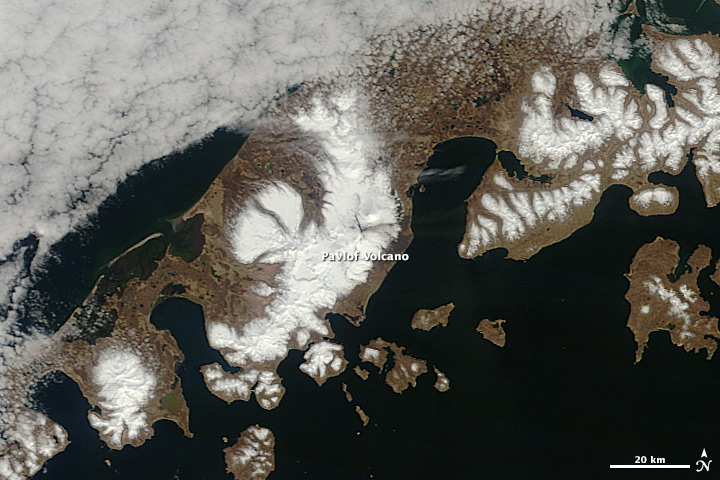
For the third time this century, Alaska’s Pavlof Volcano is erupting. The Alaska Volcano Observatory first detected earthquakes associated with the movement of magma and heat at Pavlof’s summit on May 13, 2013. The Moderate Resolution Imaging Spectroradiometer (MODIS) on the Terra satellite captured this image of a small ash plume and lava flow on the morning of May 14. Read more

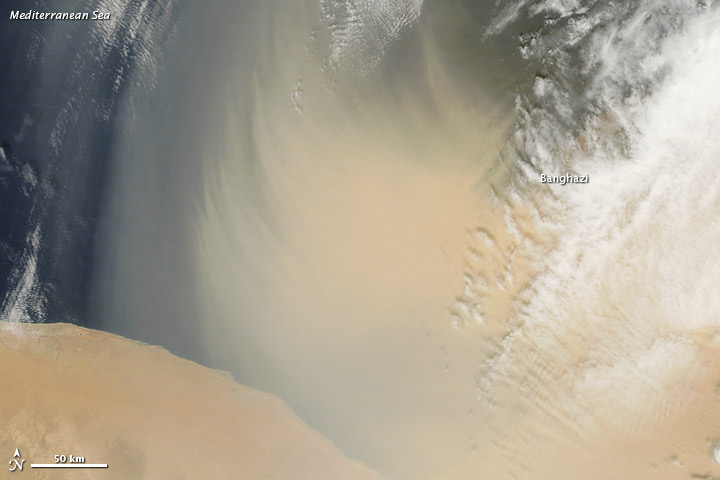
A dust storm blew out of Libya and across the Mediterranean Sea in late March 2013. Southwest of the coastal city of Banghazi (Benghazi), an especially thick dust plume spanned roughly 100 kilometers (60 miles), and the plume was thick enough to completely hide the ocean surface below. Read more

Beijing Smog

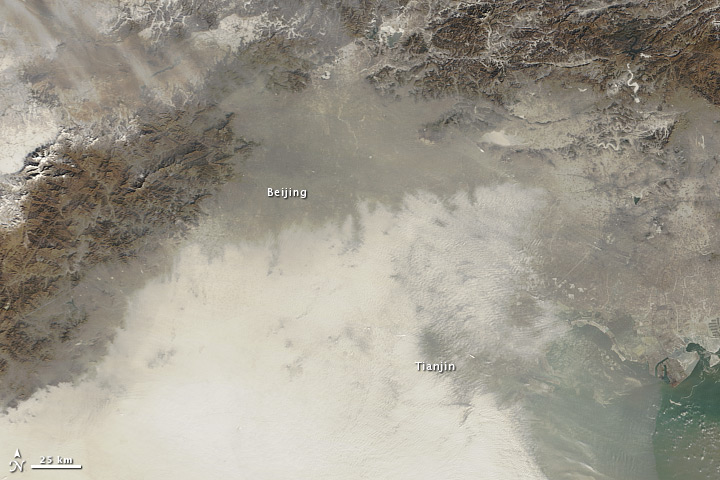
Residents of Beijing and many other cities in China were warned to stay inside in mid-January 2013 as the nation faced one of the worst periods of air quality in recent history. The Chinese government ordered factories to scale back emissions, while hospitals saw spikes of more than 20 to 30 percent in patients complaining of respiratory issues, according to news reports. Read more.

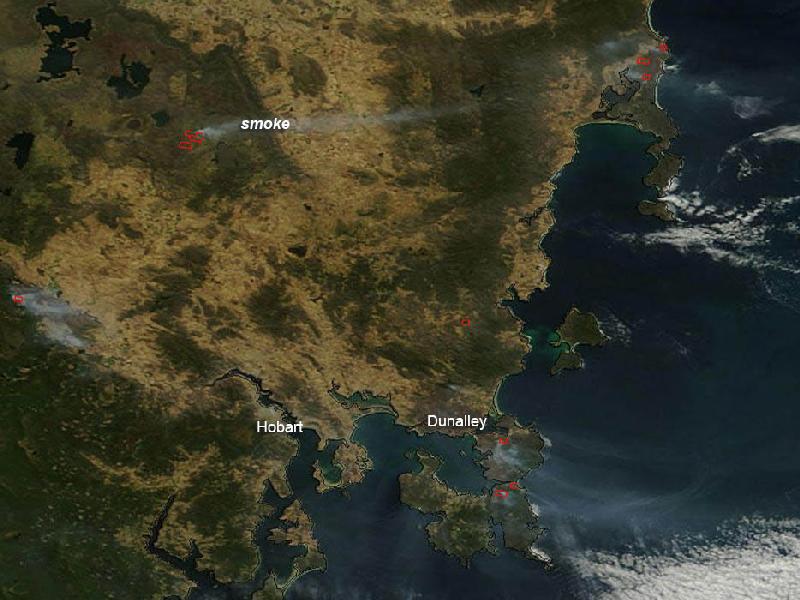
In January 2013, intense bushfires blazed in Tasmania, an island south of Australia. The Moderate Resolution Imaging Spectroradiometer (MODIS) on NASA’s Terra satellite captured this image showing numbers fires burning across the island on January 7, 2013. Red outlines indicate hot spots where MODIS detected unusually warm surface temperatures associated with fires. Read more.

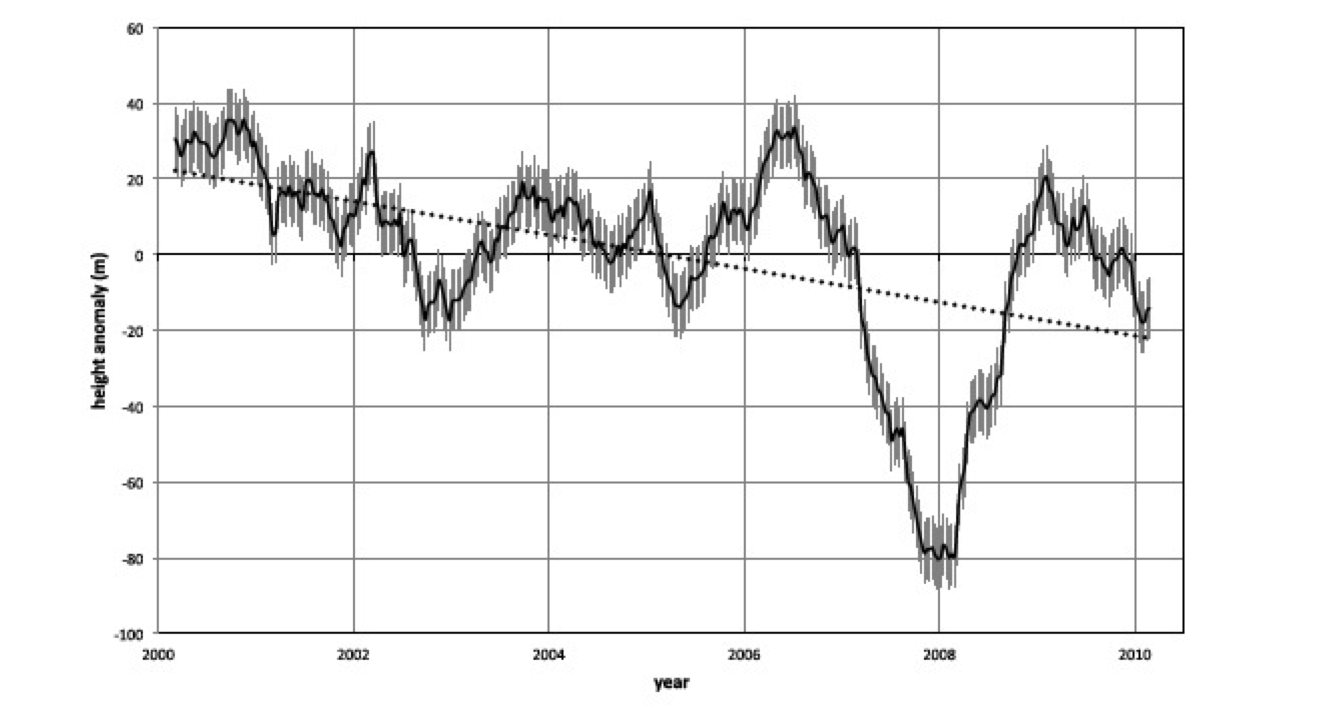
Deseasonalized anomalies of global effective cloud-top height from the 10-year mean. Solid line: 12-month running mean of 10-day anomalies. Dotted line: linear regression. Gray error bars indicate the sampling error (±8 m) in the annual average.

Stereo measurements from the Multiangle Imaging SpectroRadiometer (MISR) on the Terra satellite show a decrease in global cloud height between March 2000 and February 2010. MISR records the height of the top, thick cloud (not thin clouds), the cloud layer that has he greatest influence on radiating longwave radiation (heat) to space. Lower clouds radiate more energy than higher clouds, so a drop in cloud height could help counter rising global temperatures. In this analysis, the change in cloud height was calculated by comparing heights for a given 10-day period with the average global height calculated for that time of year over the ten-year period. The greatest change-a drop of 80 meters below average-occurred in 2007 and 2008, during a strong La Niña event. The height difference between the 2000 and 2010 is 31 meters.  The observed trend is strongly influenced by the La Niña event and may disappear over time. If the trend persists, it would represent a strong negative feedback to global warming.


Davies, R. and Molloy, M. (2012, February 3). Global cloud height fluctuations measured by MISR on Terra from 2000 to 2010. Geophysical Research Letters, 39, L03701.